
Legal AI's Real Value: Autonomy, Not Automation

It's the start of a new legal year, but some things have stayed the same. In Singapore, 60% of newly minted lawyers say they're likely to leave the profession within five years. The government just formed a committee - co-led by the Law Minister and Chief Justice - to address this crisis. It's even been given a cold lifeless name — attrition rate — like tiny bits separating from a large uncaring rock.
I suppose I was a tiny piece of rock once, so I should have an opinion about this. But with family commitments, the need to continually upgrade myself, and the constant worry that my current job will be gone tomorrow, I haven't paid much attention to it.
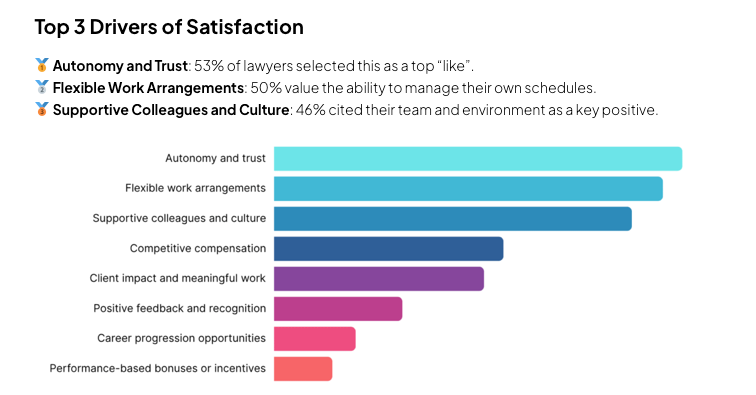
That’s why this piece of research was interesting to me: Aslant Legal's research found lawyers are seven times more likely to enjoy their work because of autonomy than because of bonuses. Autonomy and trust scored 53% as the top satisfaction driver. Performance-based bonuses? 8%.
I began to think: maybe there’s something wrong with how we are approaching this.
The Efficiency Trap
Take legal AI for example. The typical legal AI pitch is relentlessly transactional:
- Cut research time by 70%
- Draft contracts 3x faster
- Reduce costs per matter
- Do more with less
But what does this mean to a lawyer? Does drafting faster give you more flexibility with your time? Can reducing costs increase your bonus?
In the end, they mean little to a lawyer’s satisfaction.
There's a framework that explains why. Daniel Pink's Drive: The Surprising Truth About What Motivates Us identifies three intrinsic motivators that make work meaningful: Autonomy (directing your own work), Mastery (getting better at something that matters), Purpose (being part of something larger).
MIT Sloan research on AI adoption found that workers who reported gaining meaningful value from AI were 3.4x more likely to feel satisfied in their jobs.
The connection nobody's making: AI can deliver these intrinsic motivators, not just efficiency gains.
 Houfu Ang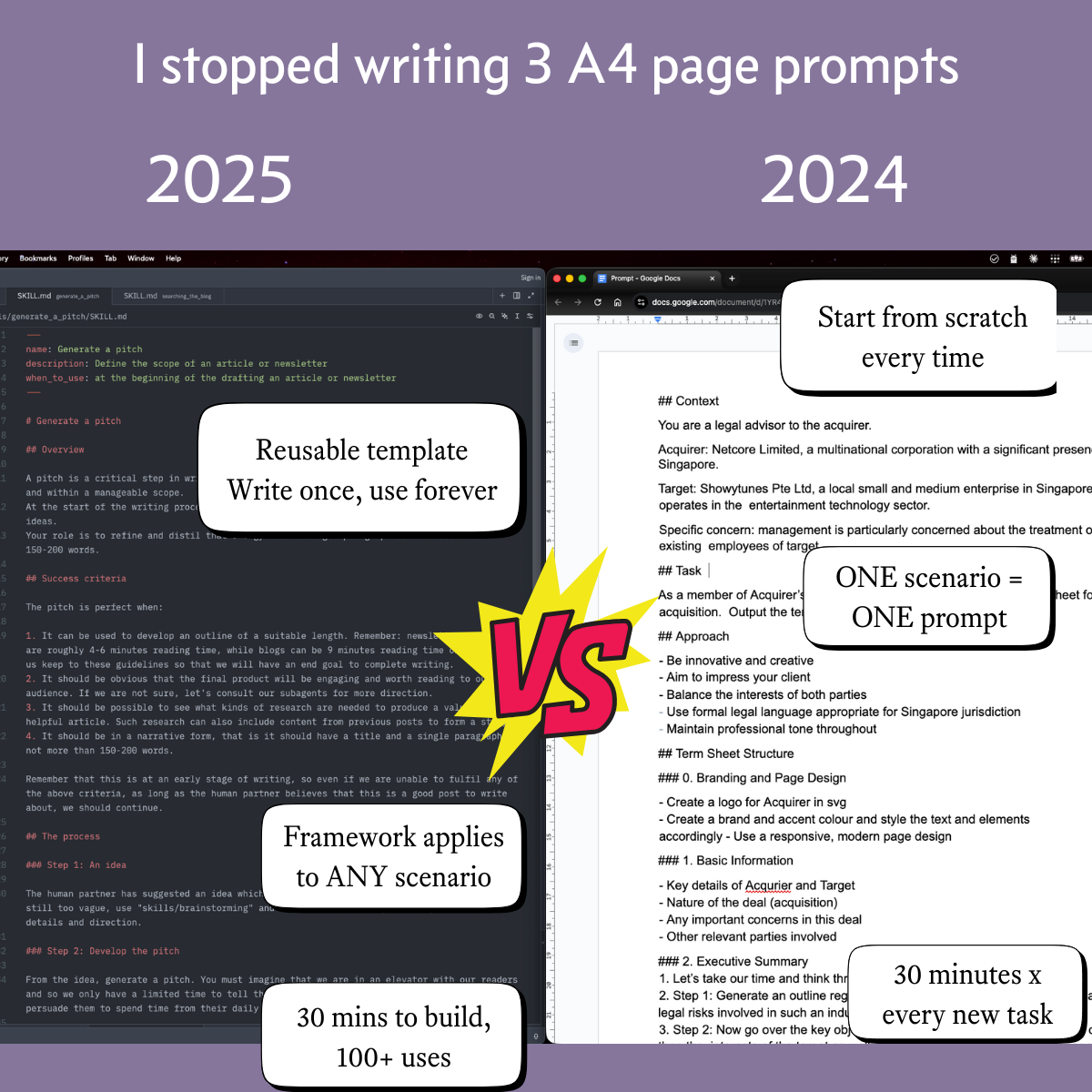
I wrote before about how legal tech training focuses on the wrong things. The pattern continues: we teach efficiency when lawyers actually need autonomy.
What AI Can Give You
Looking at how the way I worked changed recently has given me a glimpse of what is possible with AI.
Autonomy: Making decisions without fear
Early in my career, I was stuck with whatever systems existed. Document management using paper files and reams of documents. Inflexible workflows. Checking the dots on all the is in the contract. I adapted my work to the tools available.
Before AI, the real constraint wasn't knowledge - it was fear. When a client's situation didn't fit the template cleanly, I knew the optimal approach. But pursuing it meant risk: hours wasted if the custom structure didn't work out, or worse, delivering a messy draft because I couldn't execute cleanly from scratch.
Fear forced me to compromise. Use the existing template even if it doesn't quite fit. Adapt what exists rather than design what's needed.
Last month: client needed service agreement with milestone-based payments. Template used monthly billing. Optimal approach: start fresh with milestone structure. But that meant 3+ hours of drafting risk.
With AI, the risk vanishes. "Draft service agreement with payment tied to defined milestones, liability triggered by milestone failures, termination linked to milestone completion patterns." Three minutes. Doesn't work perfectly? Adjust instructions, regenerate. Third attempt gives me the foundation.
The time savings matter (3 hours to 30 minutes). But what matters more: I made the optimal decision. Not the compromise. The right call, based on what the client actually needed, without fear of the cost if I was wrong.
That's autonomy - being empowered to pursue the best approach, not just the fastest one.
Mastery: I focus on skilled work
AI handles the grunt work I used to spend hours on. Formatting documents. Extracting data from PDFs. First-pass research on routine questions. Summarizing long threads. Picking words to complete contracts.
Now I spend time on the parts that require legal judgment: negotiation strategy, risk assessment, advising stakeholders on complex decisions. Even in prompting AI, I am deciding the approach and strategy.
The work feels more like lawyering, less like administrative survival.
 Houfu Ang
This shift from execution to judgment changes everything about how work feels. I explored this when comparing different building approaches.
Purpose: I'm part of something new
This one surprised me. Using AI well requires learning new skills, experimenting with workflows, understanding what the technology can and can't do. I'm building expertise in an emerging field.
That sense of participating in a technological shift - being an early adopter who understands the tools while others are still skeptical - makes the work feel meaningful beyond the immediate task.
It's not just "I drafted this contract faster." It's "I'm learning to work in a fundamentally different way."
Why This Matters for Solo Counsels
For solo practitioners and small legal teams, the autonomy question becomes even more critical. You work alone or with minimal support. Limited budget. No IT department. No procurement team evaluating vendor options.