
The Judgment, Not the Summary: How Zeeker MCP Can Change the Way you do Legal Research
I saw it first on LinkedIn huddled between conversations between leading employment lawyers in Singapore. That's when you know it's big.
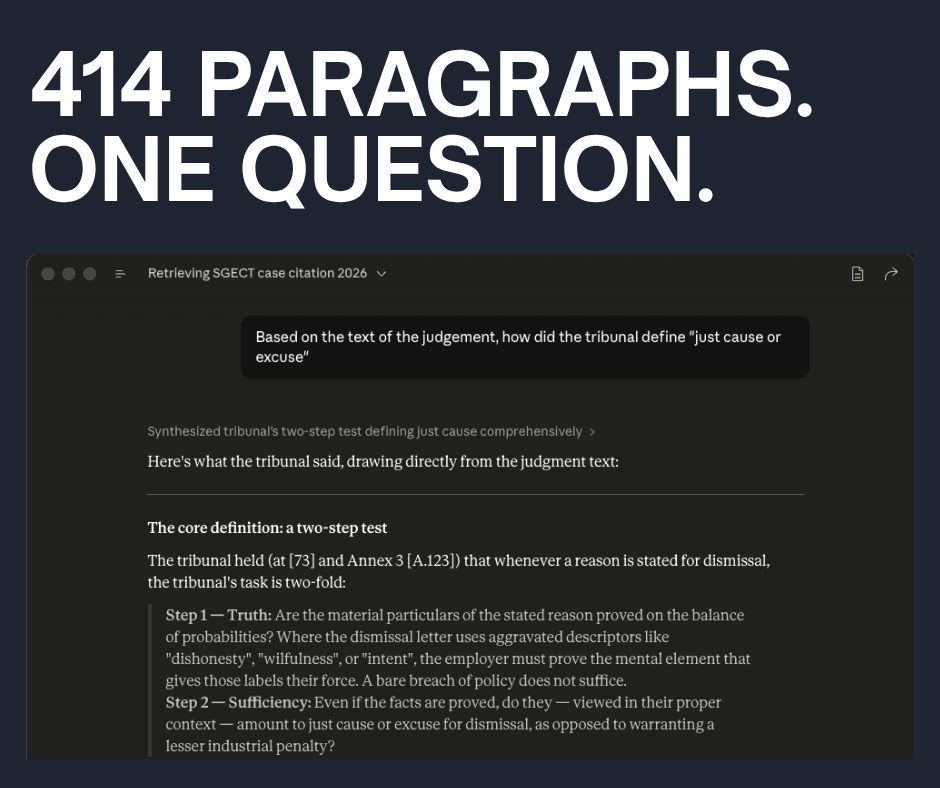
JGP v JGQ [2026] SGECT 1 is the first published ECT written grounds since the tribunal launched in 2017. At 414 paragraphs, it is also one of the most legally dense documents a Court other than the higher courts would produce. Most people facing dismissal would not find it, let alone know what to do with it.
I wondered if Zeeker could provide a better way.
What keeps changing
The facts of [2026] SGECT 1 are simple enough: employees claimed medical benefits for vitamins and skincare, the employer dismissed about 40 of them, eight challenged, six won. The employer has applied for leave to appeal.
The legal landscape around that outcome is not simple.
Four days before the ECT judgment was issued, the High Court struck out a separate wrongful dismissal claim in Seng Hock Chye Daniel v Denso International Asia Pte Ltd [2026] SGHCR 14. The claimant had worked for Denso for nearly 19 years. He believed the Tripartite Guidelines on Wrongful Dismissal protected him. The court disagreed: those guidelines guide the ECT but do not create enforceable civil rights. The claim had no legal foundation and was dismissed without a trial. The registrar's closing note directed employees to the ECT as the proper statutory channel.
In the same week: a civil court said go to ECT, and an ECT judgment explained at 414 paragraphs why the law there is layered and unsettled. Nicholas Ngo, who commented on both decisions, captured it directly: in civil court you must plead a recognised legal basis; in the ECT, the statutory test is different and the doctrine is still being worked out.
That distinction is invisible unless you can read what the courts are actually saying.
Note: the employer has filed applications for leave to appeal all six decisions. Check the appeal status before relying on the outcome in your own matter.
What the ECT was built for
The ECT launched on 1 April 2017. The State Courts release at the time was explicit: the tribunal would be low-cost, speedy, and lawyer-free. It also said ECT would not be a forum for complicated employment claims. That was the design rationale.
[2026] SGECT 1 explains, in paragraph [4], what the same forum manages in practice nine years later.
[2026] SGECT 1 is itself evidence of the gap. The tribunal wrote 414 paragraphs without opposing counsel because the law needed clarifying and the parties couldn't provide that help. The tribunal noting that the underlying map is unsettled — in a judgment — is unusual.
There is also an asymmetry the design never named. JGQ — the employer in this case — is a company. Companies facing ECT claims often have HR teams who have already reviewed the file, in-house counsel who advised on the dismissal process, or external employment lawyers retained after the complaint was filed. None of that advice appears in the tribunal record because there are no lawyers in the room. But it shaped what was in the file before the hearing. The 2017 design removed lawyers from view. It did not remove them from the picture.
The information gap
Someone who just received a dismissal letter and wants to understand what they walked into needs to know, at minimum:
- What reason did the employer give for dismissal?
- What did the employer need to prove about that reason?
- Which framework applies — ECT or the courts?
- What remedy is actually available?
What they find by Googling: MOM guidance, HR blog posts, a CNA article about skincare. None of that is the tribunal speaking in its own voice.
What you can actually ask
The Zeeker MCP (Model Context Protocol) server connects Singapore legal data to an AI workspace you already have open — Claude, ChatGPT, or any MCP-capable client. MCP is a connector standard that lets AI tools query external databases directly, without copying and pasting documents. The queries are in plain language. The answers land in plain language.
 Houfu Ang
When Institutions Enter Your Passion Project Space
Here is what the workflow actually looks like, starting from the citation. Once the connector is set up — a one-time step that takes about five minutes — the research workflow itself runs in under fifteen.
Installing the connector
Hook up your Claude Desktop app to the Zeeker MCP by adding it as a new connector under 1) Customize, 2) Connectors and 3) click the plus sign to add a connector. Use the url: https://mcp.zeeker.sg/mcp.
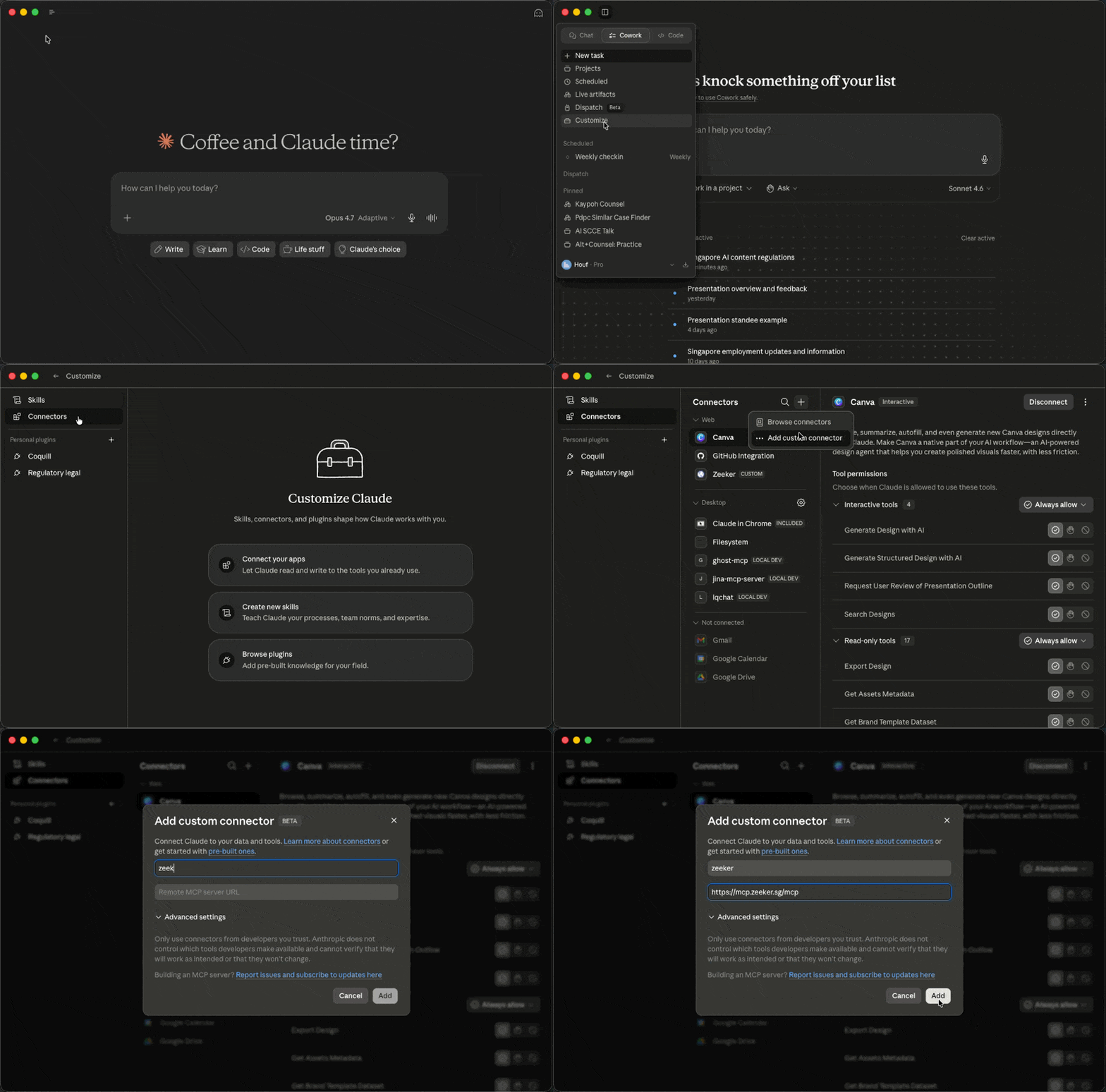
For other clients: The Zeeker MCP is a Remote MCP with the url https://mcp.zeeker.sg/mcp. You will probably need to add a custom MCP server. Currently, no passwords or authentication are needed to access it — and Zeeker does not log your queries.
Retrieve the case
Once you have access to Zeeker MCP, you can use natural language to search the database.
I'm trying to get the case with the citation [2026] SGECT 1 on zeeker.The quality of results depends on the model you use. Claude Sonnet — available on the standard $20/month Claude plan — handles citation lookups and fragment retrieval well. Claude Opus, performs better on complex multi-step reasoning, such as comparing several cases and synthesising an argument across them.
What comes back: case name (JGP v JGQ), case number (ECT/11019/2024), decision date (15 May 2026), subject tags (disciplinary procedures, discretionary bonuses, wrongful dismissal), a source URL, and 414 fragments. Zeeker breaks each judgment into numbered fragments — roughly paragraph-aligned chunks — which makes targeted retrieval possible without feeding the entire document to the model at once.
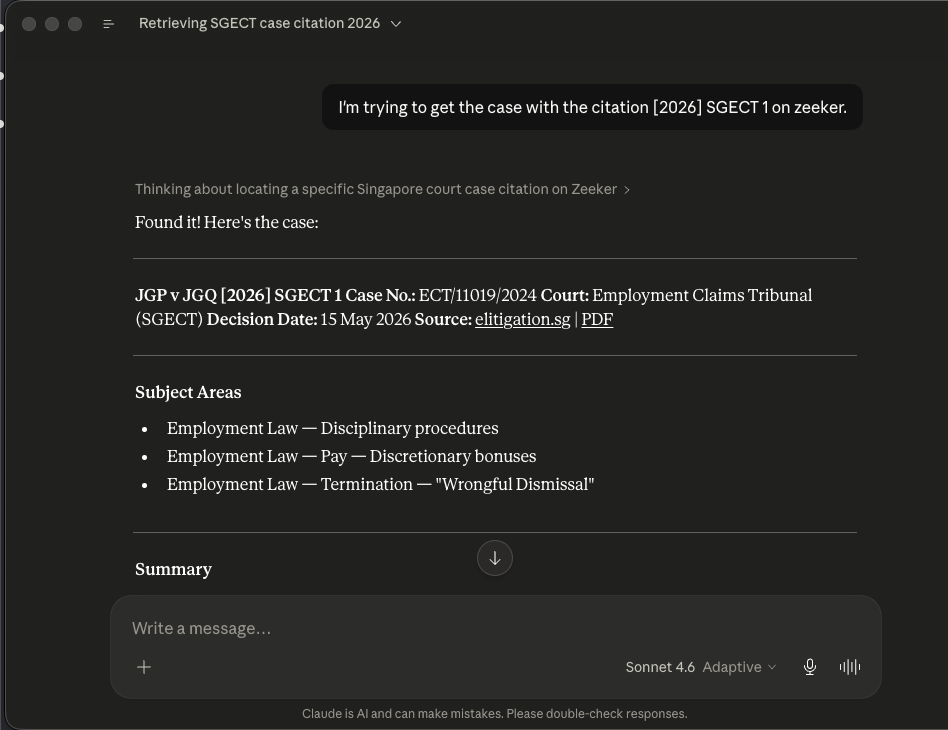
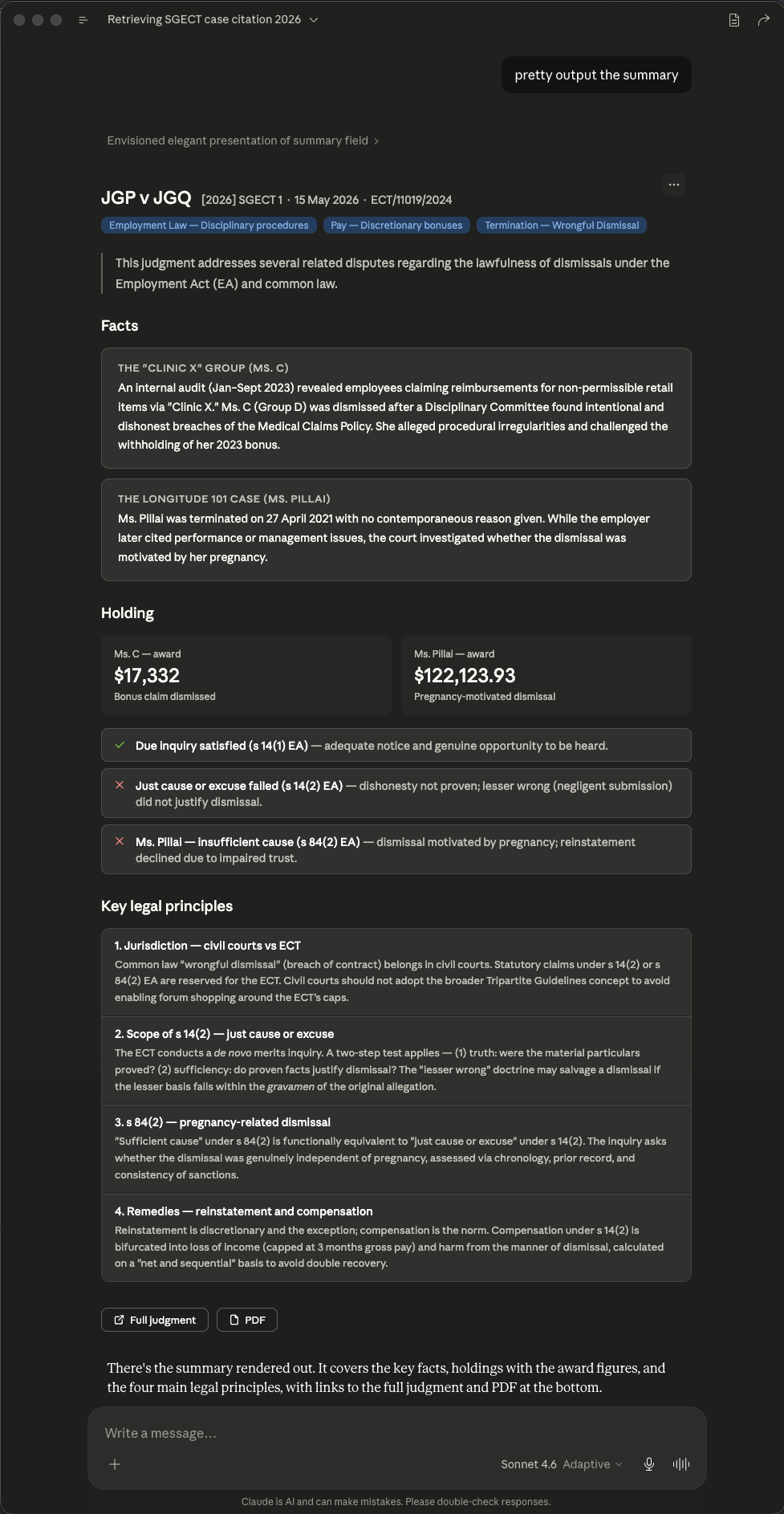
Most of the data (like citations and subject tags) comes from what is in the official link, but enriching that data is something I am continuously working on. For example, I’ve been generating summaries for judgments using AI — it does the job, but it is still a work in progress (there are more than 10,000 judgments to go through).
Once the data is available in Claude.ai or another MCP-capable client, it is straightforward to present it in more readable ways.
Ask what the employer needed to prove
The Zeeker MCP provides access to the full judgment as searchable fragments, so you can ask targeted questions rather than reading all 414 paragraphs. The query is plain language — something like "What did the employer need to prove to justify dismissal in this case?"
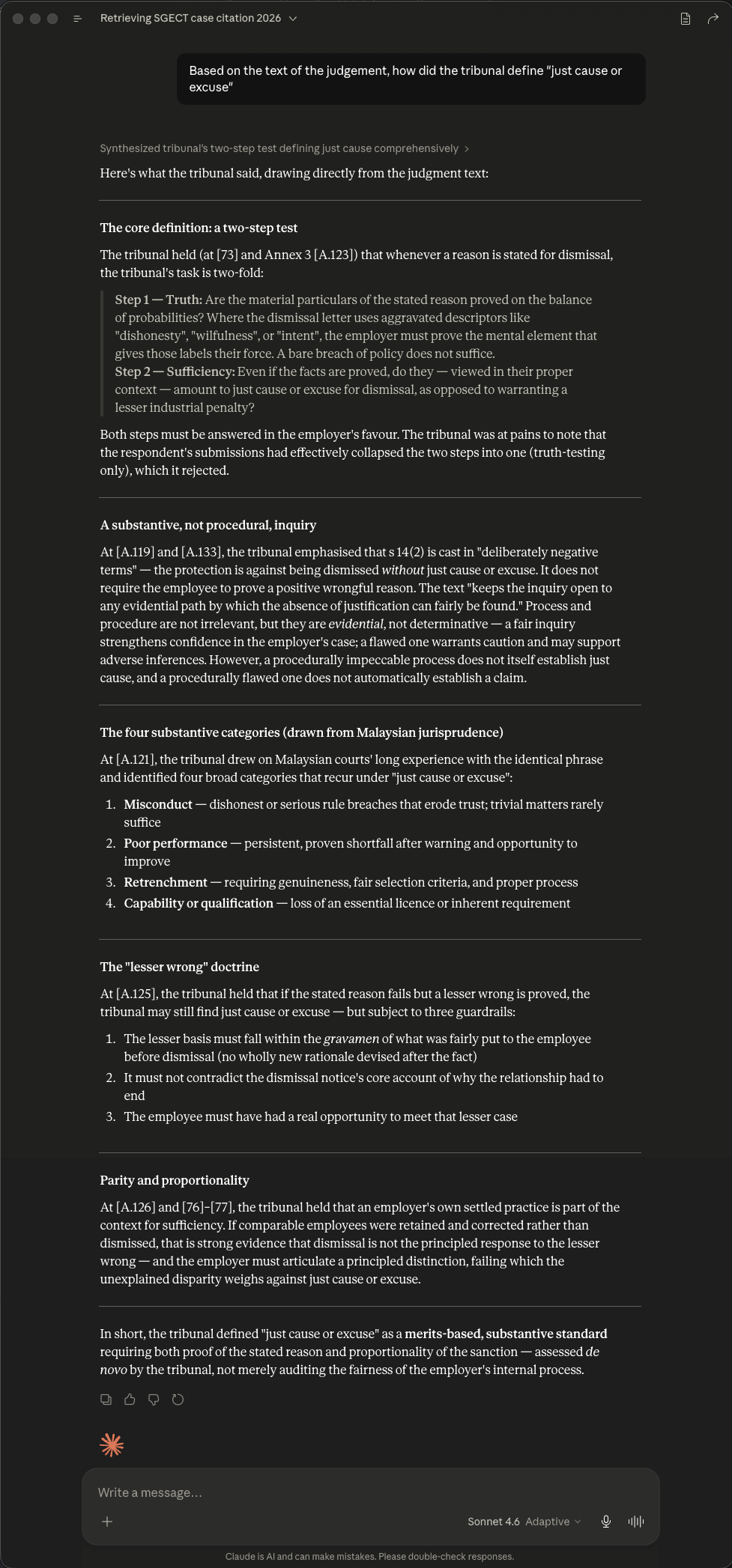
The fragment retrieval returns the tribunal's working definition of "just cause or excuse": the employer must prove that dismissal was justified by the conduct actually alleged, to the applicable standard. The conduct alleged was dishonesty. The tribunal found that bar unmet — the employee had committed a lesser wrong, negligent reliance on practice, not dishonesty — and a lesser wrong was not just cause or excuse for dismissal. That is the answer to the question most people actually had about this case, in the tribunal's own words.
Ask what arguments are more successful than others in Singapore
A potential litigant who encounters this judgment may want to get straight to the point: is this case helpful to my situation? With the judgment text available through Zeeker, Claude can give a detailed account of how it applies to a specific question.
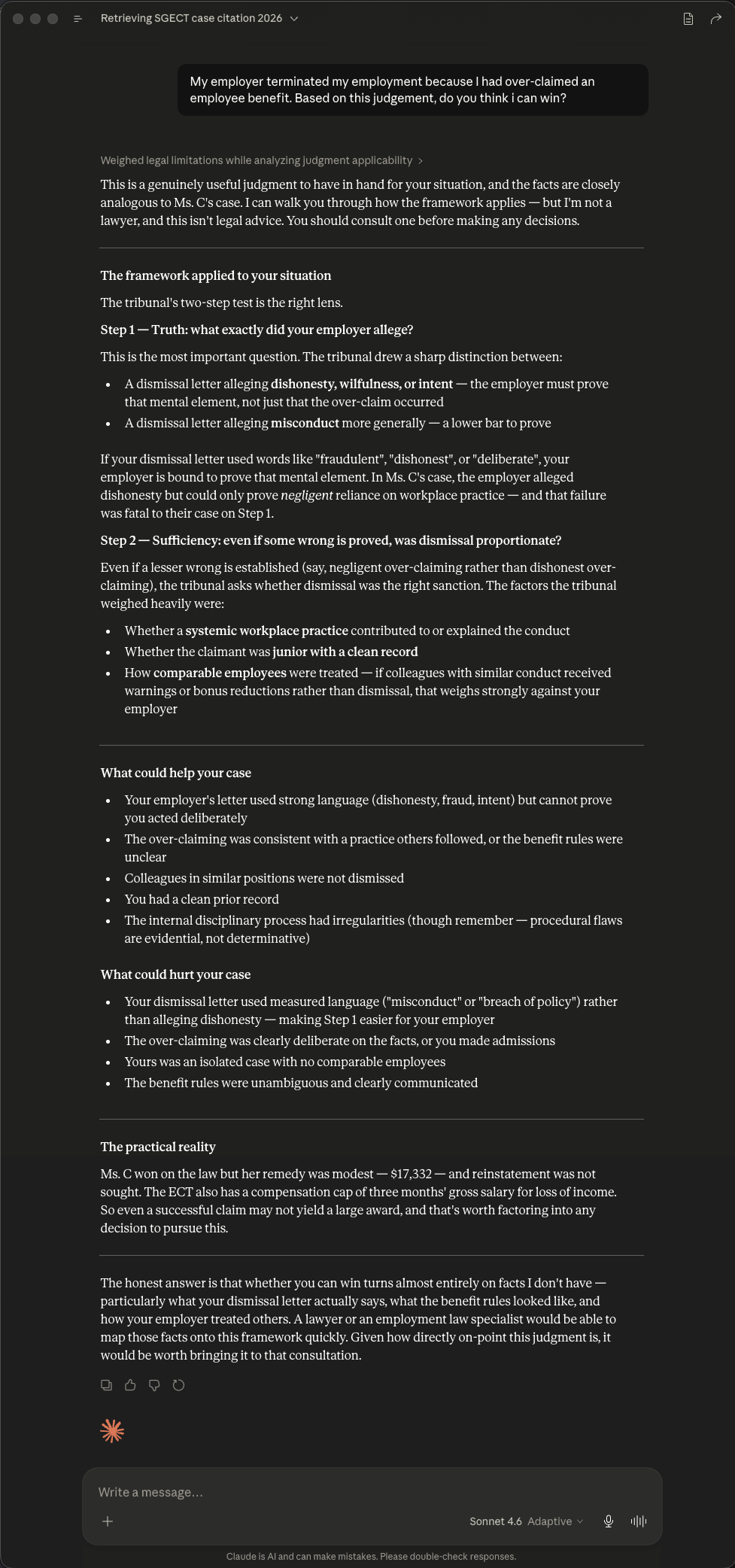
Two things stand out in the response. First, Claude defers parts of the analysis to “a lawyer or employment law specialist.” Zeeker includes a disclaimer that its content is not legal advice; Claude adds its own. This is appropriate — knowing what the tribunal decided is not the same as knowing whether you will win. Second, the response flags a “practical reality”: the monetary remedy for wrongful dismissal at the ECT is capped and may be limited. That is worth knowing before filing, and it has not changed with this judgment.
Ask what adjacent cases look like
A single judgment, however detailed, is not the whole picture. A key legal research skill is locating similar cases and reasoning about them — applying the precedent, or distinguishing it. From a claimant’s perspective, this all feeds one underlying question: will I win?
Zeeker can surface similar cases through natural language. I asked: “Are there any other materials similar to this case that might be helpful to my situation?”
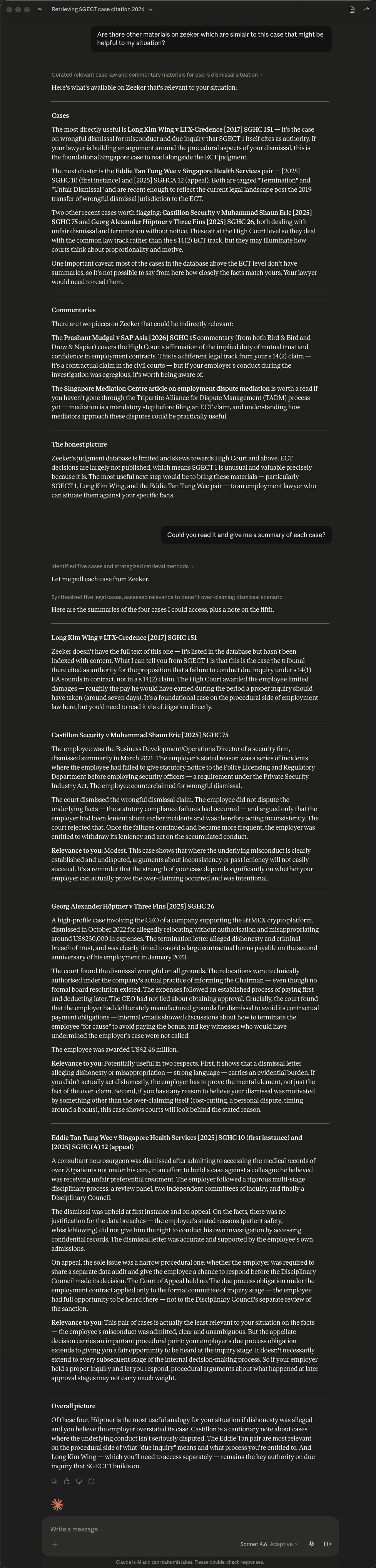
Zeeker returned five recent cases relating to wrongful and unfair dismissal, plus recent law firm commentary on the area. After a follow-up prompt asking for a direct comparison to my hypothetical, the AI worked through the cases and offered a structured assessment — which arguments were likely to succeed, and which faced headwinds. These are not predictions. They are the right questions to bring into the first hour of any ECT matter.
Comparing Zeeker with what’s out there
Paid databases like LawNet, WestLaw, LexisNexis
LawNet and its competitors have depth and longevity behind them — comprehensive data, tested design, institutional credibility. Zeeker is 1 guy and his claw. That gap in coverage is real and I am not going to pretend otherwise.
What Zeeker has that LawNet does not: MCP access. There is currently no way to connect LawNet into Claude in the way Zeeker connects. That is a meaningful practical difference — LawNet users work with legal data in one window and AI in another, which is exactly how hallucinations creep in. Zeeker with AI integration is more flexible and more hallucination-prone than LawNet without AI integration. That is not a bug in either design. It is the actual trade-off, and it will matter more as AI adoption in legal practice grows.
Zeeker is also free. LawNet requires either a subscription or a trip to a public library. Zeeker is a proof of concept and pricing has not been decided — free for now because it is still being built.
Houfu Ang
What I Learned at SMU's Legal Database Launch (And My Decision About zeeker.sg)
Searching the web
Claude and ChatGPT can search the open web directly. For basic context — news coverage, MOM guidance, law firm articles — that works. For legal reasoning, it tends to go wrong.
The web search does not understand court hierarchy, how to resolve conflicts between cases, or what stare decisis means in practice. If you use a web search to construct legal arguments, it is easy to end up with authoritative-sounding claims a court would not accept. Zeeker is a curated index of sources selected for authority — judgments, practice directions, and legal commentary. It is far from complete. But it has a better chance of giving you the right legal landscape than a general web search, and that gap will widen as Zeeker’s coverage grows.
Access isn't just entry to the room
The ECT gave employees somewhere to go without hiring a lawyer. That matters, and it was deliberately designed to matter.
But the first published ECT judgment exists because the tribunal decided the doctrine was unclear enough that it needed to say so in public, at length, without adversarial submissions to help it work through the law. The same institutional design that kept lawyers out of the room required the tribunal to do more of the explanatory work itself.
That work is now 414 paragraphs long. It is publicly available. And you can ask it questions.
For solo counsels and small legal teams, the first pass on a dense new judgment — what framework applies, what the employer needed to prove, where the adjacent cases sit — now costs an AI subscription you already have. That is not a revolution. It is the forum's own reasoning, made accessible.
What you do with the map still needs a lawyer. What you do with the blank page no longer does.
This post is open source. View the source files, discussion notes, and revision history on GitHub.




Member discussion