Every Answer Was Correct. That's What Made It Hard.
Every answer in the exam was correct. That's what made it hard.
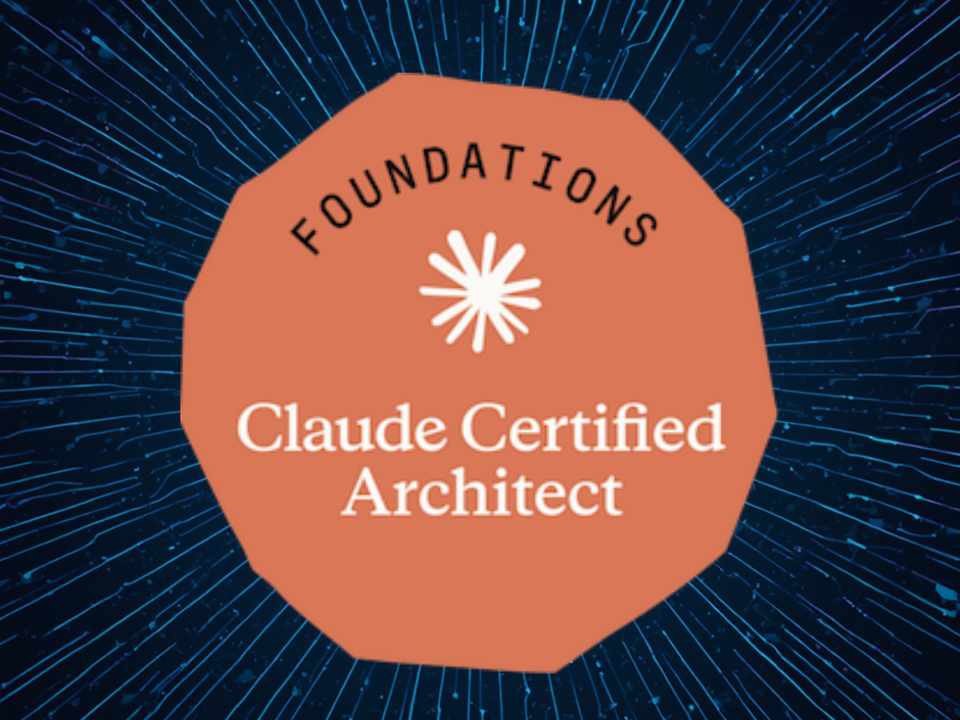
Last week I passed Anthropic's Claude Certified Architect – Foundations exam. First lawyer in Singapore to hold it, as far as I can tell. (If I'm wrong, say hi — we should talk.)
That's the part I'd put on LinkedIn. Here's the part I wouldn't: I passed, and then I sat there wondering if I could even put it on my CV.
I'll come back to that doubt. First, the exam — because it surprised me, and because what it found in me wasn't what I went in expecting.
The Kind of Question With No Wrong Answer
Here's the shape of one. Not a real question — the exam's under wraps — but close enough.
Your AI agent keeps forgetting things you told it earlier in the conversation. Do you switch to a stronger model? Give it a bigger context window? Or write the key facts into a small structured note at the start of every turn?
Every one of those is a real thing a builder reaches for. None is stupid. Pick one.
Most people pick the bigger context window. More room, less forgetting. It feels obvious.
It's also wrong. A bigger window doesn't fix forgetting — models skim the middle of a long context the way you skim a long email. A fact being in there isn't the same as the model using it. You haven't solved the problem. You've paid more to postpone it.
The stronger model doesn't fix it either. Forgetting isn't about intelligence. If the fact is buried in the middle of the context, a smarter model skims past it just the same.
The answer is the boring one. Write the key facts into a small note, every turn, so they sit in front of the model no matter how long the conversation runs. Working memory. Cheap. Dull. Reliable.
Here's the catch: the wrong answer is the intuitive one. And the only way to know it's wrong is to have watched an agent with a huge context window forget things anyway.
That's not knowledge. That's a scar.
Sixty questions like that. Nothing to memorise, because all the answers are already correct.
Experience Got Me to 90%. Then It Failed Me.
I "studied" for about a week. Mostly I didn't. I leaned on months of building with Claude, agents, and MCP — Model Context Protocol, the plumbing that lets an AI call your tools. The practice paper, sat without prep, came back around 90%.
So why bother with the last 10%? If experience gets you an A-minus, why sit the exam at all?
Because the last 10% wasn't knowledge I was missing. It was habits I'd built wrong.
One kept catching me. Hand me a problem and my reflex is to build something. A tool. A script. A new pipeline. It's the instinct that got me this far.
It's also a distortion. Sometimes the fix isn't a new tool — it's improving the one you have, or redesigning the process until the problem disappears. The exam kept offering me that choice and watching me reach for the hammer.
I know this lesson. I've written it down. And I still failed it under exam conditions, because a habit doesn't care what you believe.
That's the uncomfortable part. The thing that most makes me me — I build — was the thing the exam had to drill out of me.
 Houfu Ang
I wrote about this before: building got cheap, but knowing what to build stayed expensive.
You Don't Certify to Prove You Can Do It
Experience versus a certification. Neither is wrong.
But experience has one blind spot it can't fix on its own: it can't see its own bad habits. The repetition that makes you good is the same repetition that quietly bakes in the mistakes.
That's the gap the exam filled. Not the basics — I had those. The few places my instincts had drifted wrong without me noticing.
What actually drilled them out was a tool from LegalQuants — a community of lawyers who build their own tech. Several of us were sitting the same exam around the same time, drilling with the same AI tool, which hammers you on the principles you keep getting wrong. It kept surfacing my build-first reflex until I stopped reaching for it.
Sit with that loop for a second. An AI tool, made by a community of AI builders, drilling a lawyer for an AI exam.
So here's the reframe I didn't see coming. You don't certify to prove you can do the work. You certify to find where doing the work has quietly made you worse.
 Houfu Ang
More on the build-first instinct — and the lawyer who made me notice mine.
The Part I Didn't Put on LinkedIn
Back to the CV.
There's no job in Singapore this badge is for. Not really. AI skill shows up as a line bolted onto ordinary legal roles — "comfortable with AI tools" — not as a title you can apply for. So I earned a fresh credential for a job that doesn't exist here.
On paper, a badge for nothing.
Except the skill under the badge is the hardest thing to hire for in the country. Building AI applications just overtook traditional IT and data work as the single hardest role to fill in Singapore. The government sees the same gap. IMDA is retraining tens of thousands of tech professionals on it. Budget 2026 hands companies a 400% tax deduction on qualifying AI spending.
So — asset or vanity line? Both, honestly.
The AI-certification market crossed four billion dollars this year, 400-plus credentials deep, and the fairest criticism of all of them lands on mine too: a certificate proves exposure, not capability. It says you understand the ideas. It doesn't say you can use them when the data is messy and the problem is vague — which is the only thing the job ever actually asks.
Can I put it on my CV? I can. Whether anyone reading it yet knows what it means — that's the real question. A badge for a title that doesn't exist, pointing straight at the skill nobody can hire for.
 Houfu Ang
What "success" actually looks like for a lawyer who codes.
Last night, I received a rejection for a job that appeared to me to require someone who is innovative. Naturally I wondered, if I had put the Claude Certification in my CV would it have made a difference? I kind of doubt it to be honest. Would it change soon? I hope so.
For Solo Counsels Wondering If AI Skills Can Be Certified
If you're a solo counsel or on a small team eyeing one of these, here's the useful version.
The knowledge is cheap. Anthropic's prep courses are free, and you could work through the concepts in a few evenings. That's not the moat.
The judgment is the moat. And judgment only comes from shipping something and watching it break. You can't cram the scar that tells you a bigger context window won't save your forgetful agent. You earn it.
So get the order right. Build first — on real problems, with real stakes, until something you made breaks in a way you'll remember. Then certify, if you want a mirror held up to your habits — not to prove you can do it, but to find where your instincts have quietly gone wrong.
Build first. Certify after.




Member discussion